
Interpret Your Correlation Matrix (Pearson’s r) Instructions

Interpret Your Correlation Matrix (Pearson’s r) Instructions

by HUF04 Trần Huỳnh Gia Hân -

1. Identification of correlations

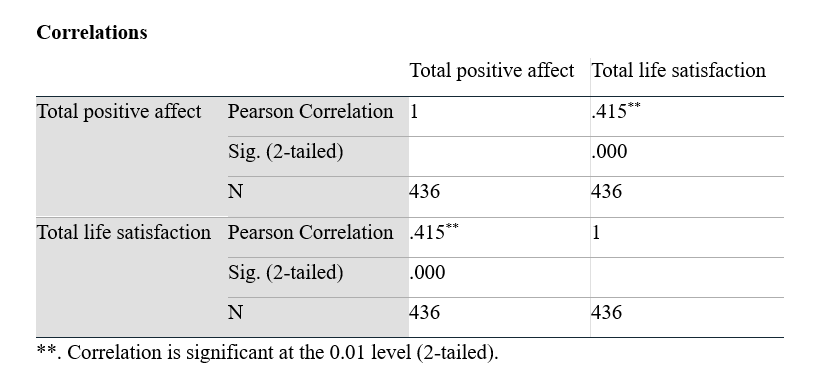
Based on the correlation matrix, there is only one correlation reported:

  • A moderate correlation between total positive affect and ...

more...

1. Identification of correlations

Based on the correlation matrix, there is only one correlation reported:

  • A moderate correlation between total positive affect and total life satisfaction (r = .415).

There are no strong (r ≥ .50) or weak (r = .10–.29) correlations available in this matrix.

2. Interpretation in plain language

  • Moderate correlation:
    There is a moderate positive correlation between positive affect and life satisfaction.
    “In simple terms, people who experience more positive emotions tend to feel more satisfied with their lives.
  • Strong correlation: Not available in this dataset.
  • Weak correlation: Not available in this dataset.

3. Comments on surprising or non-significant results

The correlation between positive affect and life satisfaction is statistically significant (p = .000), meaning the result is unlikely due to chance.

There are no non-significant relationships in the matrix. Additionally, the result is not surprising, as it is consistent with existing research suggesting that positive emotions are associated with higher life satisfaction.


Interpret Your Correlation Matrix (Pearson’s r) Instructions

by HUF04 Vo Dao Trang Thy -
Your interpretation is clear and easy to understand. I agree that the correlation between positive affect and life satisfaction is moderate and positive, and your ...

more...

Your interpretation is clear and easy to understand. I agree that the correlation between positive affect and life satisfaction is moderate and positive, and your plain-language explanation is also very clear. One small point is that since the matrix only includes two variables, it is understandable that there is no strong or weak correlation to compare. You might also mention that this result shows a meaningful relationship, but it still does not imply causation.

Interpret Your Correlation Matrix (Pearson’s r) Instructions

by HUF04 Nguyễn Đăng Hải -
I think your interpretation is clear and easy to understand, especially how you explained the moderate correlation in simple terms. Your conclusion that higher positive ...

more...

I think your interpretation is clear and easy to understand, especially how you explained the moderate correlation in simple terms. Your conclusion that higher positive affect is linked to higher life satisfaction also makes sense and is well supported.

I do have one question though—since your matrix only reports one correlation, were there other variables in the dataset that were not included in the analysis? It might be interesting to see whether other factors (e.g., negative affect or stress) show weaker or even negative correlations with life satisfaction.

Also, even though r = .415 is considered moderate, do you think it is strong enough to have practical significance, or would you suggest looking at additional variables to better explain life satisfaction?