Introduction
Feedback plays a central role in shaping student learning, particularly in English as a Medium of Instruction (EMI) classrooms where learners must engage with both subject content and language development simultaneously. Effective feedback practices must therefore support comprehension, develop academic language, and encourage learner autonomy. In EMI contexts—especially in Asian higher education—students may experience linguistic anxiety, uncertainty about expectations, and limited confidence in academic English. The lecturer’s approach to feedback can either alleviate or intensify these challenges, making it essential to adopt strategies that are clear, supportive, and learning-oriented.
Research indicates that effective feedback in EMI should be dual-focused, addressing both content mastery and the enhancement of academic English communication skills. One effective approach is the integration of peer feedback with instructor guidance. Studies show that feedback interventions combining teacher support and peer review significantly enhance students’ writing development, particularly in EFL and EMI settings where learners may struggle with academic language (Astrid et al., 2021).
Furthermore, combining peer and instructor feedback allows learners to address high-level content issues (e.g., argument clarity, organization) alongside low-level language concerns (e.g., vocabulary, grammar), resulting in more comprehensive academic development (Li & Zhang, 2021). Peer feedback also fosters learner autonomy by encouraging students to evaluate writing critically, deepen disciplinary understanding, and build confidence in their academic voice (Wijaya, 2022).
Overall, feedback in EMI is most effective when it is constructive, collaborative, and scaffolded. By balancing teacher guidance with peer interaction, EMI classrooms can cultivate stronger academic performance, improved communication skills, and greater learner independence, supporting students’ long-term success in multilingual academic environments.
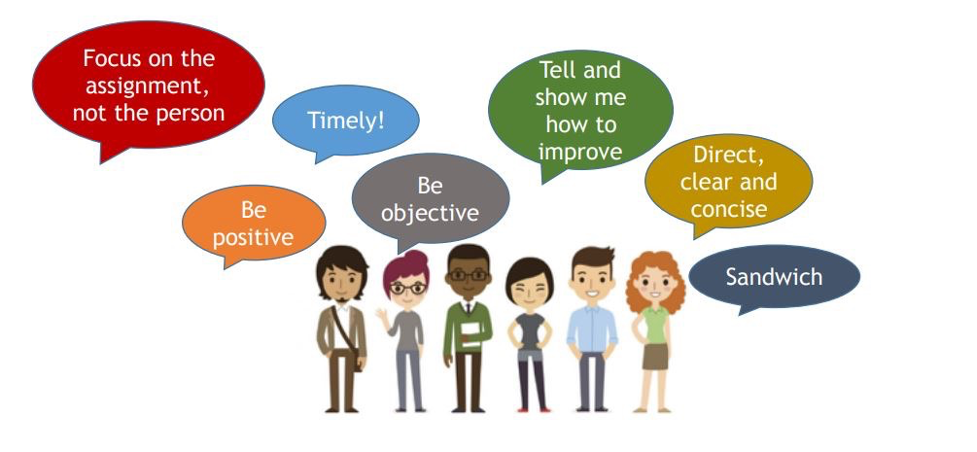
Types of Feedback in EMI Contexts
1. Content-Focused Feedback
Content-focused feedback emphasizes conceptual understanding, accuracy, and disciplinary thinking. This is crucial in EMI classrooms because students must demonstrate knowledge beyond linguistic performance. Lecturers should clarify misconceptions, highlight key frameworks, and draw links between classroom discussion, readings, and real-world contexts. Examples include explaining why an argument lacks evidence, or how a data interpretation could be strengthened.
2. Language-Sensitive Feedback
Language-sensitive feedback attends to clarity, structure, vocabulary, and academic tone. However, it must avoid overwhelming students with excessive corrections. Selective focus is essential: prioritize errors that affect communication or understanding. Feedback can target the structure of explanations, transitions, referencing, and specialized terminology. Using sentence frames—for instance, “A clearer way to express this concept is…”—supports students’ language growth without discouraging them.
3. Process-Oriented Feedback
Process-oriented feedback encourages reflective learning by highlighting strategies for improvement rather than just results. It prompts students to consider how they approach tasks, gather information, or collaborate. In EMI, where learners may hesitate to ask questions, this type of feedback fosters metacognitive awareness and independent learning.
Delivering Feedback Effectively
Clarity and Simplicity
Feedback should be linguistically accessible. Use clear sentence structures, avoid unnecessary idioms, and check for comprehension. This maintains academic rigor while ensuring inclusivity.
Balancing Praise and Guidance
Balanced feedback acknowledges effort and achievement while suggesting actionable next steps. Overly critical feedback risks lowering confidence, whereas vague praise lacks developmental value. Aim for comments that affirm progress and direct improvement.
Using Multimodal Feedback Channels
Lecturers can provide written annotations, audio feedback, or short video explanations. Audio and video formats often convey tone more warmly and reduce misinterpretation, supporting student motivation.
Encouraging Peer and Self-Assessment
Peer and self-assessment broaden opportunities for feedback and enhance learners’ critical awareness of academic communication. When guided with structured criteria or rubrics, students learn to evaluate clarity, coherence, and validity of ideas. These practices help students internalize expectations and transfer those standards into their own work.